
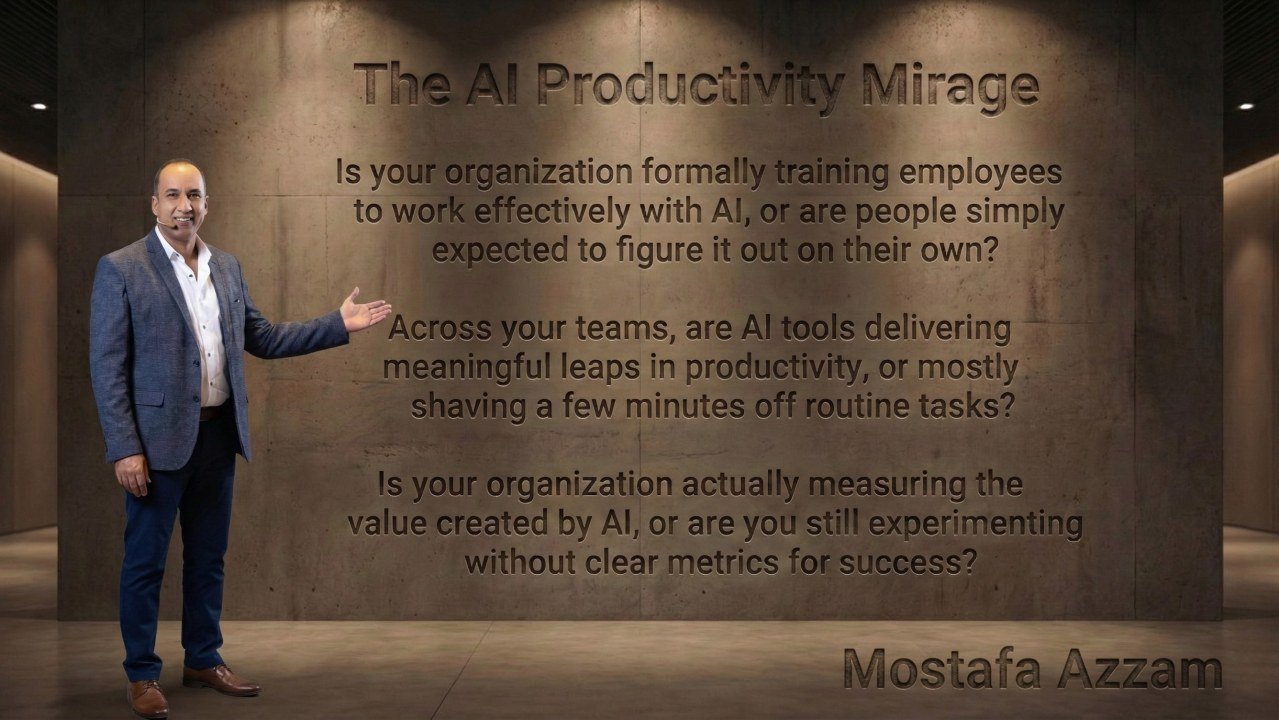
Companies across the world are racing to adopt AI, yet early evidence suggests the productivity revolution many predicted has barely begun. The explanation may lie not in the technology itself, but in how organizations redesign work around it.
A Quiet Contradiction Inside the Modern Workplace
These questions reveal a contradiction that is beginning to surface across many organizations. Artificial intelligence has moved from curiosity to corporate priority at remarkable speed. Companies are purchasing licenses, deploying generative tools across departments, and encouraging employees to experiment with AI assistants in their daily work. Intelligent systems now summarize meetings, draft reports, analyze data, and generate insights in seconds, creating the impression that the modern workplace is undergoing rapid transformation.
Yet, when leaders examine the results more carefully, the picture becomes less certain. Adoption rates continue to rise, but measurable productivity improvements remain difficult to identify. Many professionals report using AI tools only intermittently rather than embedding them deeply into everyday workflows. The contrast between technological enthusiasm and operational impact therefore raises an uncomfortable question for leadership teams:
If artificial intelligence is as transformative as many believe, why are its productivity gains still so difficult to see?
The Evidence Gap: Adoption Is Outpacing Impact
One of the clearest indications of this pattern emerges from research conducted by the Hoover Institution at Stanford University. Researchers examined several large economy-wide business surveys designed to track how organizations are actually using artificial intelligence in practice.
Their findings reveal a striking gap between adoption and integration. Roughly seventy percent of firms report adopting some form of AI technology, suggesting that artificial intelligence has already crossed the threshold from experimental innovation to mainstream business infrastructure. Yet the same surveys indicate that most professionals use these tools for only about one and a half hours during a typical working week. The technology has therefore spread rapidly across organizations without yet becoming deeply embedded in their core operating rhythms.
Even more revealing are the productivity estimates reported by firms themselves. Across the surveys analyzed, the measurable productivity impact attributed to AI remains extremely modest, amounting to roughly 0.29 percent over a three-year period. These numbers fall far short of the sweeping productivity transformation many early forecasts predicted and instead suggest that the economic effects of AI may still be in their early stages.
The Measurement Crisis: Most Organizations Cannot Prove AI’s Value
A second body of research highlights another dimension of the challenge. A global survey conducted by Thomson Reuters examined how organizations measure the impact of artificial intelligence initiatives across multiple industries.
The findings reveal a widespread absence of structured evaluation. More than eighty percent of professionals report that their organizations either do not track the return on investment of AI at all or are unsure whether such measurement systems exist. Even in sectors where measurement traditionally dominates, including law firms and corporate risk management functions, formal frameworks for evaluating AI impact remain surprisingly uncommon.
This absence of measurement creates a significant blind spot for leadership teams. Organizations are investing heavily in artificial intelligence technologies while lacking reliable systems to determine whether those investments are producing real value. Without disciplined evaluation, leaders struggle to identify which applications of AI genuinely improve performance and which merely create the appearance of progress.
A Familiar Economic Pattern
Taken together, these findings point toward a phenomenon economists have encountered before. When powerful new technologies emerge, businesses invest quickly in order to remain competitive. Adoption spreads across industries, expectations rise, and the technology becomes visible throughout the workplace, yet measurable productivity gains often take far longer to appear.
In 1987, Nobel Prize-winning economist Robert Solow captured this tension in a remark that has since become famous. The computer age, he observed, could be seen everywhere except in the productivity statistics. At the time, companies were investing heavily in information technology, yet productivity growth remained stubbornly slow. Over time researchers discovered that the productivity benefits of computing did eventually emerge, but only after organizations redesigned workflows, management practices, and operational processes around digital technology.
Artificial intelligence may now be entering a similar phase. Economists often describe innovations such as electricity, computing, and artificial intelligence as general-purpose technologies, meaning they have the potential to reshape entire industries. Their productivity effects rarely appear immediately because the surrounding systems of work must adapt first. Workflows, skills, management practices, and decision structures evolve gradually, which means the economic impact of the technology often lags behind its initial adoption.
This growing disconnect between technological capability and organizational change creates what can be described as the AI Productivity Mirage.
The Real Barriers: Three Structural Gaps
Understanding this paradox requires looking beyond the technology itself and examining how organizations integrate AI into their systems of work. Across industries, three structural gaps appear repeatedly in organizations experimenting with artificial intelligence.
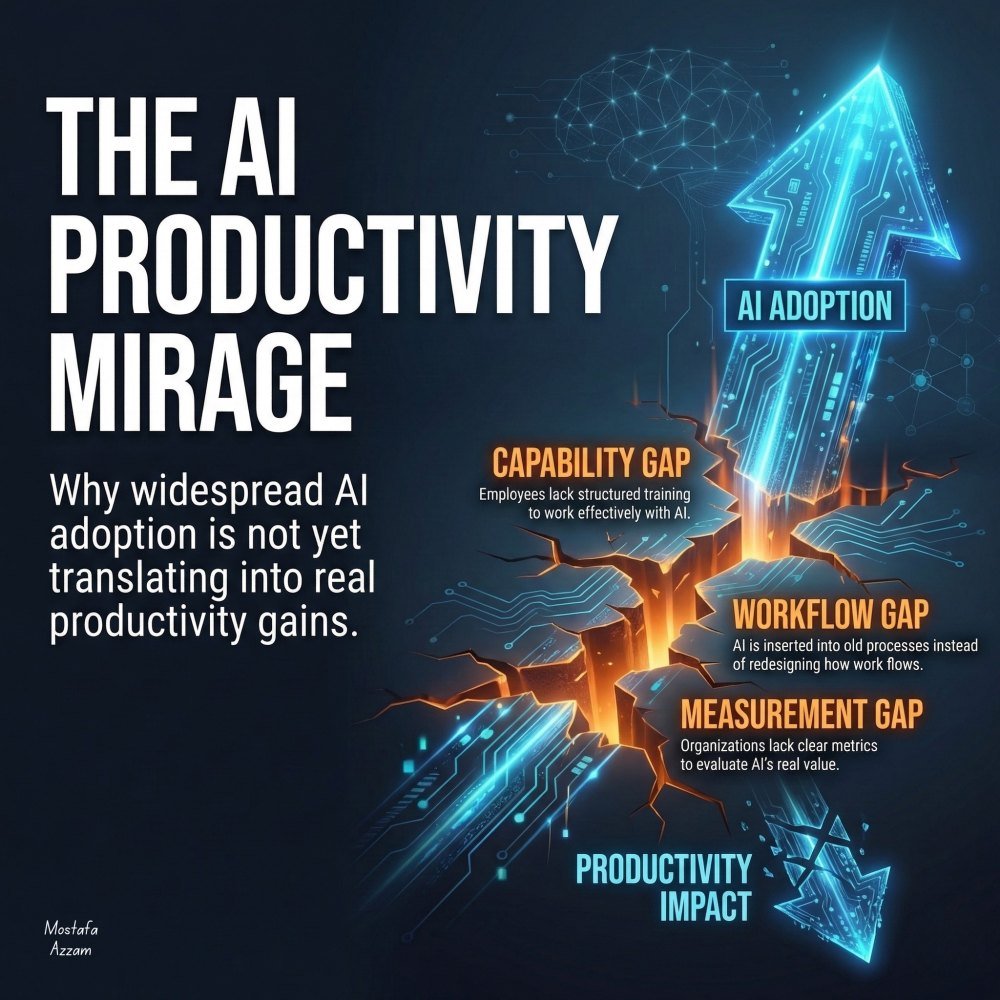
The first is a capability gap. Many companies have deployed AI tools without meaningfully preparing their workforce to collaborate with them. Employees are encouraged to experiment with generative systems, yet structured training on how to redesign tasks around human-machine collaboration remains limited. As a result, most usage remains superficial and task focused rather than strategically embedded in everyday work.
The second is a workflow gap. Technology rarely transforms productivity on its own. Meaningful gains usually occur when organizations redesign the processes through which work flows. Yet in many companies AI has simply been inserted into existing workflows rather than prompting leaders to rethink those workflows entirely. Tasks may accelerate, but the broader system continues to operate much as it did before.
The third is a measurement gap. Many organizations have invested heavily in artificial intelligence technologies while lacking clear frameworks to determine whether those investments are generating value. Without reliable metrics, leaders struggle to distinguish genuine productivity improvements from the perception of progress, which makes it difficult to scale successful applications or abandon ineffective ones.
The Leadership Imperative
For executives and HR leaders, the lesson emerging from these signals is both simple and uncomfortable. Artificial intelligence will not deliver productivity gains merely because organizations deploy it. Technology does not transform companies on its own; real transformation occurs when leaders redesign how work is structured around that technology.
The current wave of AI adoption risks repeating a familiar mistake from earlier technological revolutions. Companies are investing heavily in powerful tools while leaving the underlying architecture of work largely unchanged. When new technologies are layered onto outdated processes, inefficient workflows, and unclear decision structures, the result is not transformation but the acceleration of the same problems that already existed.
This moment therefore demands a shift in leadership thinking. Instead of asking only which AI tools to deploy, executives must begin asking deeper questions about how work itself should be redesigned and how human judgment can interact effectively with intelligent systems. Organizations that ultimately unlock the productivity promise of artificial intelligence will not be those that deploy the most tools, but those willing to rethink workflows, redefine roles, and build capabilities that allow humans and machines to operate as an integrated system.
The productivity revolution promised by artificial intelligence may still arrive. If it does, its impact will depend less on the technology itself than on leaders willing to rethink how work is organized, how people collaborate with intelligent systems, and how value is measured across the enterprise.
References
Hoover Institution, Stanford University. (2024–2025). Artificial Intelligence and the Labor Market: Evidence from Economy-Wide Business Surveys. Analysis based on multiple U.S. business surveys examining AI adoption, usage patterns, and productivity expectations.
Solow, R. M. (1987). We’d Better Watch Out. New York Times Book Review. The observation later known as the Solow Productivity Paradox, highlighting the gap between widespread computer adoption and measurable productivity growth.
Thomson Reuters. (2025). Future of Professionals Report. Global survey examining how organizations across legal, corporate, tax, and risk functions adopt and measure AI technologies.
Brynjolfsson, E., Rock, D., & Syverson, C. (2017). Artificial Intelligence and the Modern Productivity Paradox: A Clash of Expectations and Statistics. National Bureau of Economic Research Working Paper. Analysis of why general-purpose technologies often produce delayed productivity gains.
Bresnahan, T., & Trajtenberg, M. (1995). General Purpose Technologies: Engines of Growth? Journal of Econometrics. Foundational research explaining why technologies such as electricity, computing, and AI generate productivity gains only after complementary organizational changes.
First published on LinkedIn.