From Learning Events to Complete Learning Solutions: Learning Architecture, Technical Content Transformation, Performance Support, and AI-Assisted Development
Signature programTalent Architecture & Capability Development
Experienced talent development professionals rarely struggle with the mechanics of instructional design. They struggle with what happens at its edges: learning that is designed as a single event when performance depends on practice and reinforcement over time; technical and operational content that arrives as procedures, standards and expert knowledge rather than teachable material; and solutions that are complete on paper but never tested as one coherent learner experience.
This three-day advanced program builds on the foundations of instructional design (ADDIE, needs assessment, learning objectives, instructional methods, course maps, design documents and evaluation) and deliberately does not repeat them. Instead, it concentrates on the design capabilities that foundation programs touch only lightly, and on the design judgment that separates an experienced designer from a competent one: learning architecture, technical content transformation, and practice and performance support.
AI runs through the whole program, not as a topic but as a working partner under human design judgment. Every module ends with a short AI accelerator applied to that module’s task; a dedicated module turns those moments into a practical, quality-controlled AI-assisted development workflow; and the closing review puts an AI assistant in the reviewer’s chair, so participants see where its critique helps and where it misleads.
Every design choice is held to four tests: does it change what the learner can do on the job; does it respect the learner’s real conditions; is it the lightest intervention that works; and can the organization build and maintain it.
At a glance
PortfolioSignature Programs
Transformation pillarTalent Architecture & Capability Development
01Extend a single learning event into an end-to-end learning journey covering preparation, core learning, practice, reinforcement and workplace application
02Allocate learning components across classroom, virtual, digital, social and on-the-job environments based on the outcome, the audience and operational constraints
03Produce a curriculum map and a learning design blueprint that connect outcomes, modules, activities, assessments, resources and application points, and that can be reused across programs
04Sort complex technical and operational information into three tiers: what must be held in memory, what moves to pre-work and digital briefings, and what moves to job aids for use at the point of need
05Convert technical procedures and expert knowledge into clear, learner-centered content using decision-centered design, chunking, worked examples and instructional storytelling
06Design realistic case studies, scenarios and simulations with decision points and consequences, aligned to intended outcomes
07Facilitate structured debriefs, using the What? So What? Now What? framework, that convert activity experience into workplace application
08Design job aids and performance-support tools that support performance at the point of need and reduce training content
09Use AI tools to draft learning content faster, including first drafts of digital and micro-learning versions, and check every AI output against the source before it is used
10Evaluate a complete learning solution for alignment, coherence, engagement, feasibility and workplace applicability, following the thread from business outcome to objective, journey, content, practice, job aid and evidence
How it runs
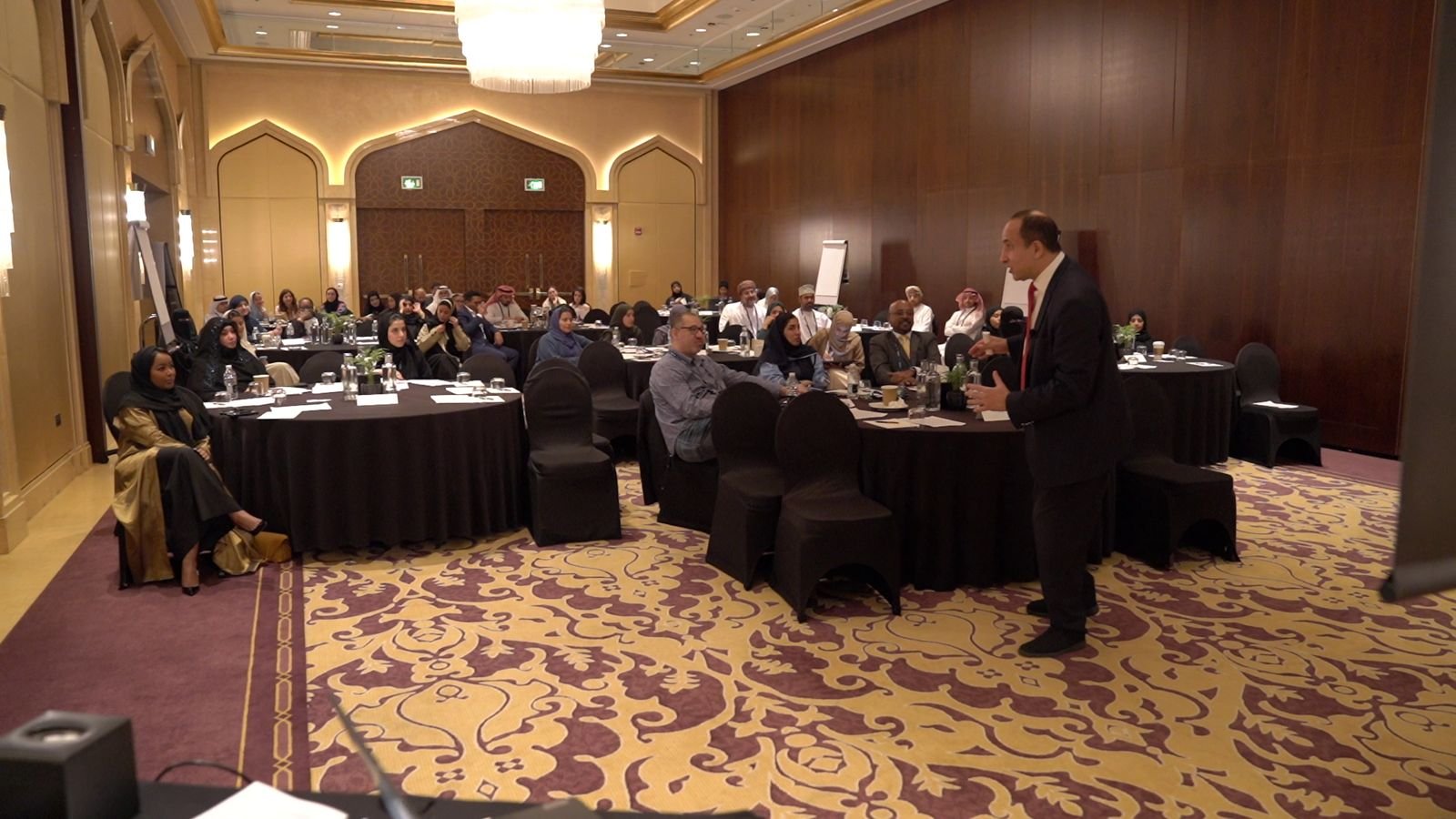
A highly interactive, practice-oriented workshop. Short expert-led inputs focus on design decisions rather than theory. Design teams work through a running case, a fictional GCC power and water distribution company, told in four episodes, where each episode’s output is the next episode’s input. Three hands-on design sessions each produce a tangible artifact: a learning journey map and design blueprint, a converted content sample, and a scenario with its debrief guide and job aid. Each participant applies every module’s decision to one real learning project of their own on a Working Project card, and the program closes with a structured peer design review, with an AI assistant as the final reviewer.
Participants take back a learning journey map and blueprint, a tiered content sort, a scenario with its debrief guide, a one-page job aid, a digital micro-learning draft, an AI-assisted development workflow checklist and the full templates pack.
Tools explored: ChatGPT, Claude, Gemini, Microsoft Copilot, Perplexity, NotebookLM, Gamma, Canva, Articulate Rise 360 and Synthesia (demonstration), and Miro. The program focuses on design judgment rather than tool proficiency; no technical or programming skills are needed.
Who should attend
Training and talent development professionals who have completed a foundation program in instructional design
Instructional designers, learning specialists and learning business partners responsible for technical, operational, safety, systems and leadership programs
Technical trainers and training supervisors who convert procedures, standards and expert knowledge into learning
L&D professionals who commission, review or quality-assure learning solutions developed by vendors or internal subject matter experts
This is an advanced program. It assumes working familiarity with ADDIE, learning objectives, instructional methods and course design documents, and builds on these foundations rather than re-teaching them.
 Workshop in session