
The difference between personal experimentation and changing the way your business actually runs!
The experiment that never leaves the laptop
Ask any HR team whether they use AI, and most hands go up. One person drafts job descriptions in ChatGPT. Another summarizes engagement comments in Claude. A third keeps a folder of favorite prompts.
Now ask a harder question: which of your HR processes runs differently today because of AI? The room usually goes quiet.
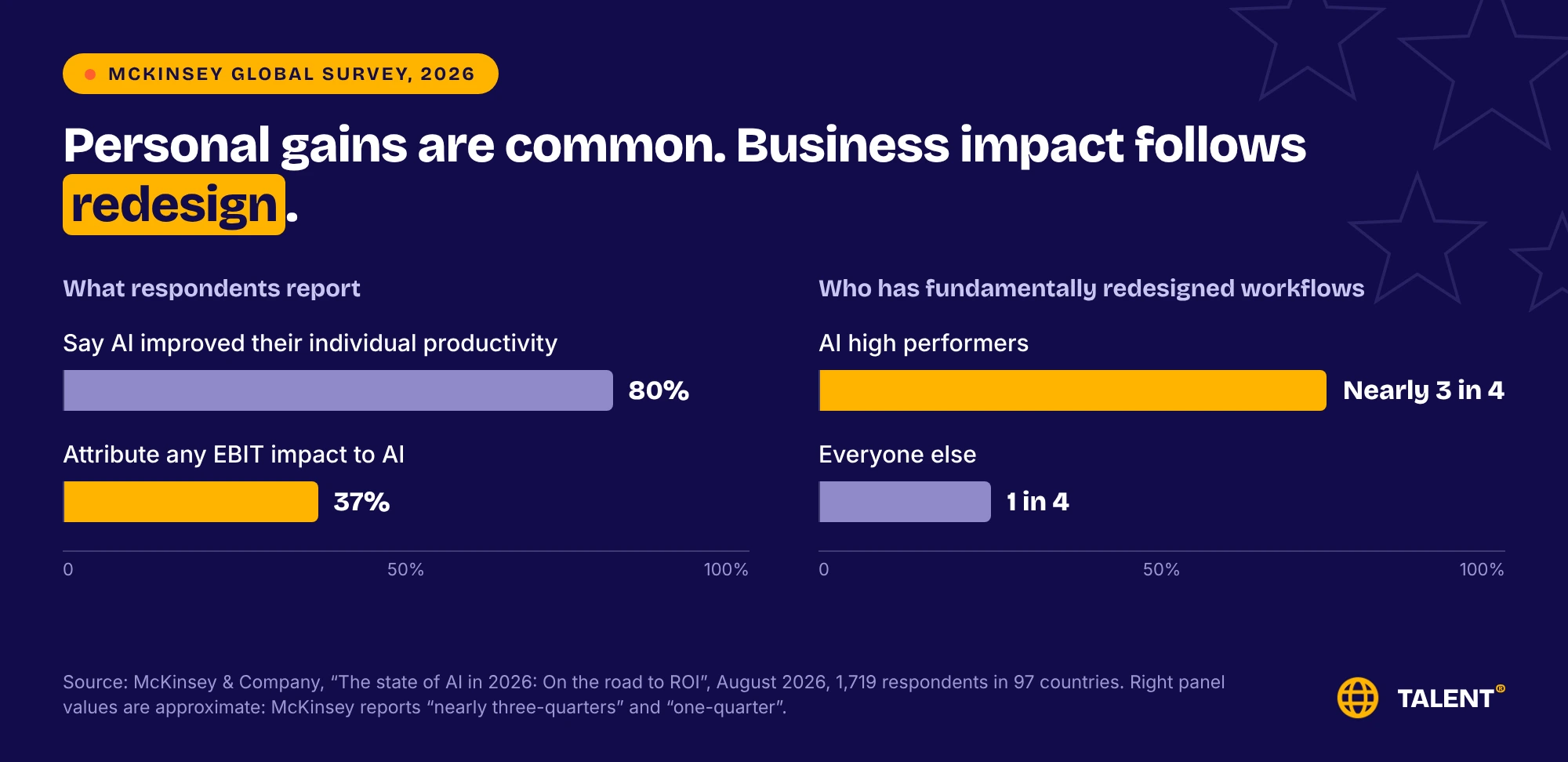
That silence is not a technology problem. It is the gap between personal experimentation and organizational change, and the latest data puts a number on it. In McKinsey’s 2026 global survey (1,719 respondents in 97 countries), 80 percent say AI has improved their individual productivity. Only 37 percent attribute any EBIT impact to it. McKinsey’s own verdict: individual gains “have yet to translate into broad financial impact.”
More prompting will not close that gap. Design will.
What a prompt does, and what a workflow does
A prompt is a conversation between one person and one model, at one moment. It is useful. It is also invisible to the organization: nobody else can see it, repeat it, check it or improve it. When that person goes on leave, the “process” goes with them.
A workflow is something the business relies on. It starts the same way every time, works from the same approved information, produces output in the same shape, passes the same checks and leaves a record. It runs on a Thursday afternoon while the person who designed it is on a plane.
Put simply, a prompt makes one person faster. A workflow changes how the work gets done.
Your people are already doing the first. Microsoft and LinkedIn’s 2024 Work Trend Index found that 78 percent of AI users bring their own AI tools to work. The second happens only when someone designs it.
From prompt to workflow: one HR example
Take a request every HR team knows: a hiring manager needs a job description.
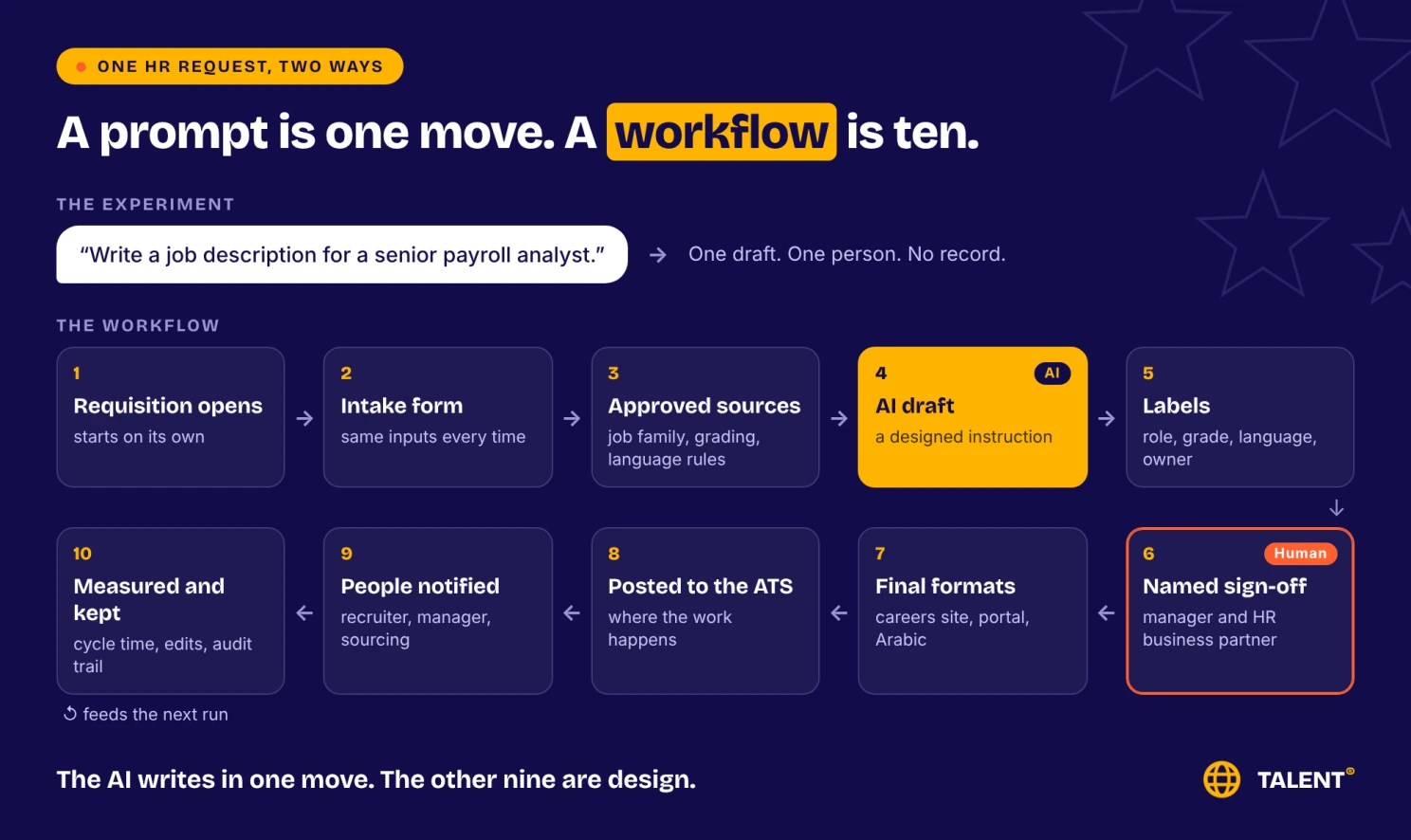
The experiment. A recruiter opens a chat window, types “write a job description for a senior payroll analyst”, tidies the result and emails it. Ten recruiters do this ten different ways, and no one can say which version went out or why.
The workflow. Most of the design work happens before and after the AI writes a single word:
- Something sets it off. A new requisition in the HR system triggers the process, not a reminder sitting in someone’s inbox.
- The right inputs come in, every time. One intake form asks for grade, reporting line, location, must-have skills and the business reason, in a fixed structure.
- It works from what the company has approved. Before drafting, it retrieves the role’s job family, the competency framework, the grading guide and the house rules on inclusive language.
- AI drafts. This is where the prompt lives: no longer a blank chat window, but a designed instruction that generates from clean inputs and trusted sources.
- The draft is labeled. Each version is tagged by role family, grade, language and owner, so anyone can find, filter and compare it later.
- A named person signs off. The hiring manager and an HR business partner review it against a short checklist and approve it. Nothing reaches a candidate without that step.
- It takes its final form. The approved text is packaged for the careers site, the internal portal and the Arabic version.
- It lands where the work happens. It is published to the applicant tracking system, not left in a chat history.
- The right people hear about it. The recruiter, the hiring manager and the sourcing team are notified that the role is live and what happens next.
- It learns and leaves a trail. Cycle time, edits made at approval and candidate quality are measured, and every version and approval is retained for audit and for improving the next run.
Count the moves. The AI writes in one of them. The other nine are decisions about inputs, sources, controls, people and measurement, and those are the decisions that change how a business runs.
Why this belongs to HR, not only to IT
The organizations getting real value from AI tend to redesign the work itself. In the same McKinsey survey, nearly three-quarters of AI high performers report fundamentally redesigning workflows. Among everyone else, it is one in four.
Redesign raises questions that technology cannot answer on its own:
- Who owns the process? A workflow crosses roles. If nobody owns it end to end, it decays the first time a system or a policy changes.
- Where does a person decide? Any step that affects someone’s job, pay or career keeps a human approval point, and the workflow records who approved what.
- Which information may it use? Approved sources and clear data rules come first. Speed comes second.
- What changes for people? Roles shift, new skills are needed, and managers have to trust the output before they rely on it.
- How will we know it worked? Cycle time, quality, user experience and trust, measured before and after.
IT connects the systems. Only the people who own the process can decide how it should run. That makes HR professionals the natural designers of these workflows, with IT as the enabling partner.
How my workshops are built around this
The sequence above is not a one-off example. It is the logic of my 10-Step API Workflow Model™, and every applied AI workshop I design and lead is built around it.
That shapes what happens in the room:
- Participants bring a process they run today. Not a case from another company, but their own request, report or approval chain.
- They map it before they automate it. What sets it off, what goes in, which sources are trusted, where AI drafts, where a person approves, where the output lands, who is told and what gets measured.
- Prompting is taught as one step, not the whole story. Structured prompting with tools such as ChatGPT, Claude and Gemini, placed inside a governed process.
- They build it. With no-code tools such as Zapier, Make or Power Automate. No coding needed.
- They leave with a working, auditable workflow. Not a list of prompts.
Two chances to work this way in the coming weeks:
- Certificate in AI-Powered Learning & Development, Leadership & People Week London, 14 to 17 December 2026, where I am Workshop Director with Informa Connect Academy. Over four days, participants build and demonstrate AI-enabled L&D workflows. CPD certified, with the conference day on 13 December included. 20% off through my link: https://app.ingo.me/q/2zxdw
- AI-Driven HR Transformation, our first TALENT® public program of 2027, live online from 09:00 to 13:00 Riyadh time: 4 to 6 January in English and 11 to 13 January in Arabic, with never more than 10 participants. Dates and seats
Both can also run in house for your team, in English or Arabic, on your own processes.
A test you can run this week
Pick one HR process your team touches every week. Then ask: if the person who built our AI shortcut left tomorrow, would this process still run the same way?
If the answer is no, you have a prompt. If the answer is yes, you have a workflow.
Want a quick read on where your function stands? My free AI Readiness Assessment takes about 7 minutes and scores five dimensions, including workflows and impact: take the assessment
Which HR process would you turn into a workflow first? Tell me in the comments on LinkedIn.
Sources
- McKinsey & Company, The state of AI in 2026: On the road to ROI, 25 August 2026 (1,719 respondents in 97 countries, surveyed May to June 2026).
- Microsoft and LinkedIn, 2024 Work Trend Index, 8 May 2024 (31,000 people in 31 countries).
First published on LinkedIn.