
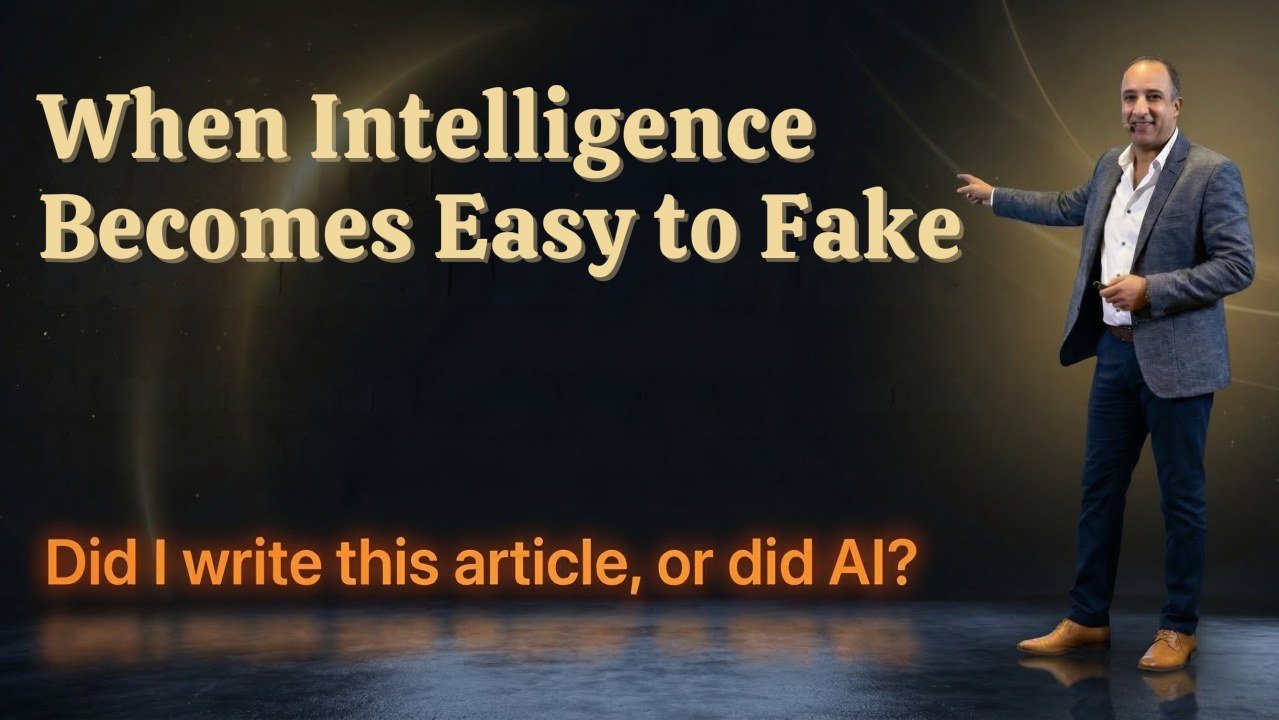
If AI can imitate the visible signals of expertise, how do we recognize the real thing?
A Leadership Puzzle Is Emerging
Something unusual is happening in professional life. We have never had more intelligent commentary, yet it has never been harder to know which ideas to trust.
A few months ago, a senior executive described a frustration that many leaders are beginning to recognize.
Over the past year, his organization had invited several well-known advisors and speakers to discuss artificial intelligence and the future of work. Each presentation was thoughtful, articulate, and filled with persuasive frameworks. The ideas sounded convincing, the analysis appeared rigorous, and the vision of the future seemed clear.
Yet, when the leadership team tried to translate those insights into concrete action, progress stalled almost immediately.
The frameworks were elegant, but the path from concept to implementation remained unclear. When the team began asking practical questions about operational constraints, pilot experiments, and lessons from failed attempts, the answers became noticeably less precise.
The executive summarized the experience in a single sentence:
“We have never had more intelligent commentary about the future of work. But it has never been harder to know which ideas are grounded in real experience.”
His observation captures a deeper shift that may define the coming decade. As generative AI makes it easier to produce polished analysis and persuasive commentary, the visible signals of intelligence are becoming easier to imitate than ever before.
The Signals We Once Trusted
For most of modern professional life, the signals of intelligence were relatively easy to recognize. Clear writing suggested disciplined thinking. Structured arguments implied familiarity with a subject. When someone could explain a complex idea with clarity and confidence, we assumed that clarity had been earned through years of effort, reflection, and experience.
Today, those signals can be generated in seconds.
Generative AI now makes it possible to produce articulate essays, structured analysis, and polished commentary in seconds. With the right prompt, anyone can generate writing that sounds thoughtful, analytical, and authoritative. LinkedIn feeds, newsletters, conference stages, and strategy decks now overflow with confident insights about leadership, artificial intelligence, and the future of work.
At first glance, this appears to be a triumph of intellectual democratization. More people can express ideas clearly. More voices can participate in professional conversations.
Yet, beneath this surge of articulate expression lies an emerging paradox. The more polished our professional conversations become, the harder it is to determine whether we are encountering genuine expertise or its increasingly convincing imitation.
For centuries, intelligence revealed itself through expression. Today, expression can be automated.
The Day the Signals Broke
This shift does not mean expertise has disappeared. Knowledge, judgment, and experience remain as valuable as ever. What has changed is our ability to recognize them.
Historically, professional credibility depended on a series of visible signals. Individuals who could communicate complex ideas clearly were assumed to understand them deeply. Writing ability, analytical clarity, and persuasive frameworks functioned as proxies for knowledge.
Generative AI has altered that arrangement with remarkable speed. Large language models can now synthesize research, construct arguments, and generate commentary across an astonishing range of topics. The outward markers of expertise, structured reasoning, articulate language, persuasive tone, can now be simulated through carefully constructed prompts.
What we are witnessing is not the disappearance of expertise. It is the collapse of the signals we once relied on to recognize it.
The result is a professional environment where the performance of authority becomes easier than the accumulation of knowledge itself.
The Rise of Expertise Theater
In many professional environments today, the performance of expertise is becoming easier than its development.
Consider three increasingly common situations:
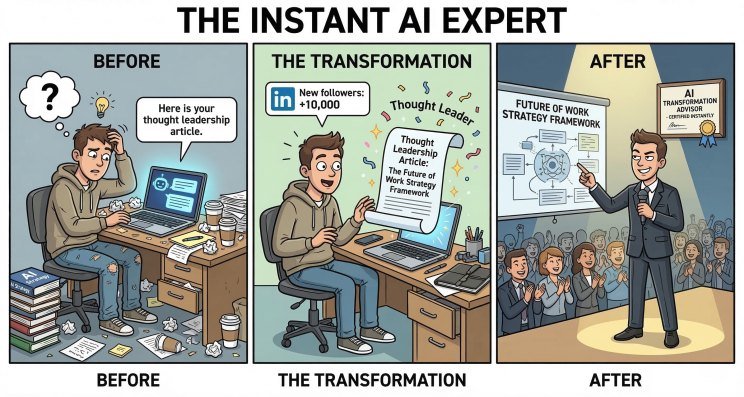
First, the Instant AI Expert. Professionals who rarely wrote publicly suddenly publish weekly essays, polished frameworks, and strategic commentary with perfect grammar and structure. The content appears sophisticated, yet it often mirrors patterns produced by generative models rather than insights drawn from real operational experience.
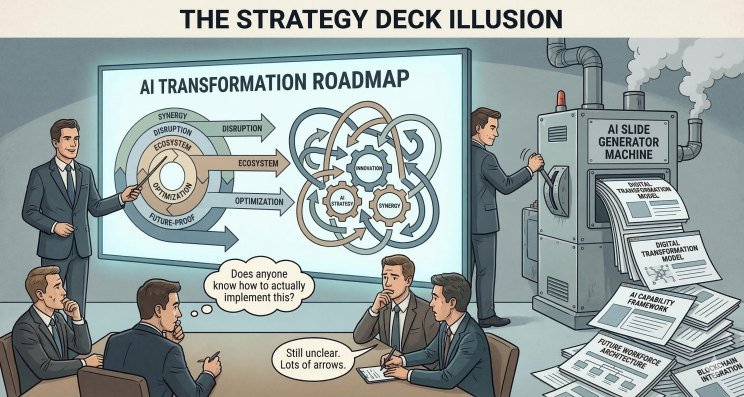
Second, the Strategy Deck Illusion. Organizations receive beautifully constructed presentations about digital transformation or AI strategy. The slides are elegant, the frameworks persuasive, and the narrative compelling. Yet, when leaders begin asking practical questions about implementation, vendor selection, operational constraints, or failed pilots, the discussion often becomes vague.
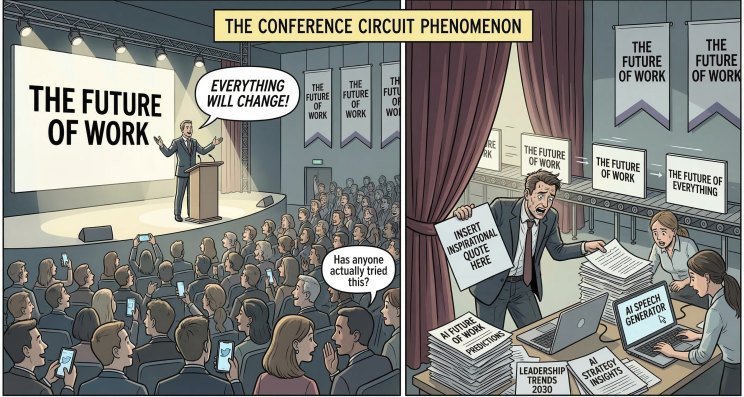
Third, the Conference Circuit Phenomenon. Audiences regularly encounter speakers offering sweeping predictions about the future of work, leadership, or artificial intelligence. These presentations are inspiring and intellectually stimulating. But, when the conversation shifts toward real experiments, operational trade-offs, or unexpected failures, the depth of experience behind those predictions becomes very hard to verify.
None of these situations imply bad intentions. The individuals involved may genuinely believe in the ideas they are presenting. But, together they reveal a subtle shift in professional life: Authority is becoming performative.
The problem facing organizations today is not a shortage of ideas. It is a shortage of reliable signals that distinguish real expertise from its imitation.
A New Credibility Test for Leaders
For leaders and organizations, this shift creates a subtle but significant challenge. Strategic decisions increasingly rely on ideas presented with clarity and authority. When the outward signals of expertise can be reproduced instantly, distinguishing between genuine understanding and persuasive performance becomes far more complicated.
If the traditional signals of expertise are weakening, the criteria by which credibility is judged must evolve.
One useful shift lies in the questions leaders ask when evaluating ideas. Instead of asking someone for their perspective on a trend, it may be more revealing to ask what they have actually built, tested, or changed in that domain.
A perspective can be assembled from summaries and synthesized research. Experience leaves traces that are far more difficult to imitate. Those traces appear in operational detail. Practitioners can describe the constraints they encountered, the assumptions that proved incorrect, and the adjustments required when plans met reality. They can explain how their thinking evolved as experiments produced unexpected results.
These signals of experience are harder to fabricate because they emerge from engagement with real problems. Perhaps this is the deeper shift unfolding beneath the surface of the AI revolution. As the language of expertise becomes easier to generate, credibility increasingly belongs to those who can demonstrate where their ideas have been tested.
Rediscovering the Meaning of Expertise
Artificial intelligence is one of the most powerful intellectual tools humanity has ever created. It accelerates discovery, expands access to knowledge, and helps people express ideas with remarkable clarity.
Yet, its most consequential impact may not be technological. It may be epistemological.
AI is forcing us to reconsider how we recognize expertise in the first place. For generations, the ability to articulate persuasive arguments served as visible proof of understanding. Today, those signals can be produced instantly. The language of intelligence has become widely accessible. What remains scarce is the experience that gives that language meaning.
In the years ahead, the most trusted voices may not be those who simply describe the future with elegance. They will be those who can show what they have attempted, what they have learned, and how their thinking has evolved through real engagement with complex problems.
Artificial intelligence can imitate many of the signals of intelligence. Experience remains the one signal it cannot fake!
Which raises one final question:
😉
First published on LinkedIn.