
A senior partner at a Dubai-based law firm confided in me recently, his voice a mixture of fascination and unease. “The new associates,” he said, “are taking career advice from a machine. They quote its recommendations to me in meetings with a finality they once reserved for legal precedent.” This quiet revolution is not confined to the halls of law firms. In my work with leaders across the UAE, Saudi, and the APAC region, a new pattern is emerging: employees are increasingly turning to AI as a trusted advisor, creating a silent, systemic challenge to traditional leadership authority. This shift is not about disobedience; it is about a fundamental recalibration of trust based on perceived objectivity, consistency, and psychological safety. The central question for today’s leader is no longer how to use AI, but how to lead when your team trusts it more than they trust you!
The New Gravity of Trust: Why AI is Gaining Ground
Trust is not monolithic. It is built on specific pillars, and AI systems are proving exceptionally adept at reinforcing them. This migration of trust does not happen without cause. It flourishes in environments where leadership is inconsistent, opaque, or inaccessible.
AI provides unwavering consistency. A machine does not have bad days, succumb to cognitive biases, or play favorites. Its analysis remains constant, a quality that can be incredibly compelling in organizations where managerial feedback is perceived as inconsistent or politically influenced. A 2024 study by the Drucker Institute found that 48% of knowledge workers expressed higher confidence in AI-generated performance analytics than in managerial reviews, citing the perceived neutrality of the data as the primary reason.
Furthermore, AI offers absolute psychological safety. Employees often hesitate to share career uncertainties, ambitions, or doubts with a manager for fear of judgment or repercussion. An AI coach presents a risk-free confidant. Research from the Yale School of Management (2023) indicates that employees disclose significantly more information about career aspirations and workplace challenges to an AI system than to their direct supervisors.
However, this trust is conditional. One visible error can flip a team from reliance to refusal, a phenomenon known as algorithm aversion. Durable trust is not built on infallibility but on visible safeguards. Leaders earn it by showing confidence ranges on recommendations, providing a simple appeal route to a human reviewer, and publishing what was fixed after an error. When people can see the controls, they are willing to rely again.
The Trustline: Five Thresholds for Algorithmic Authority
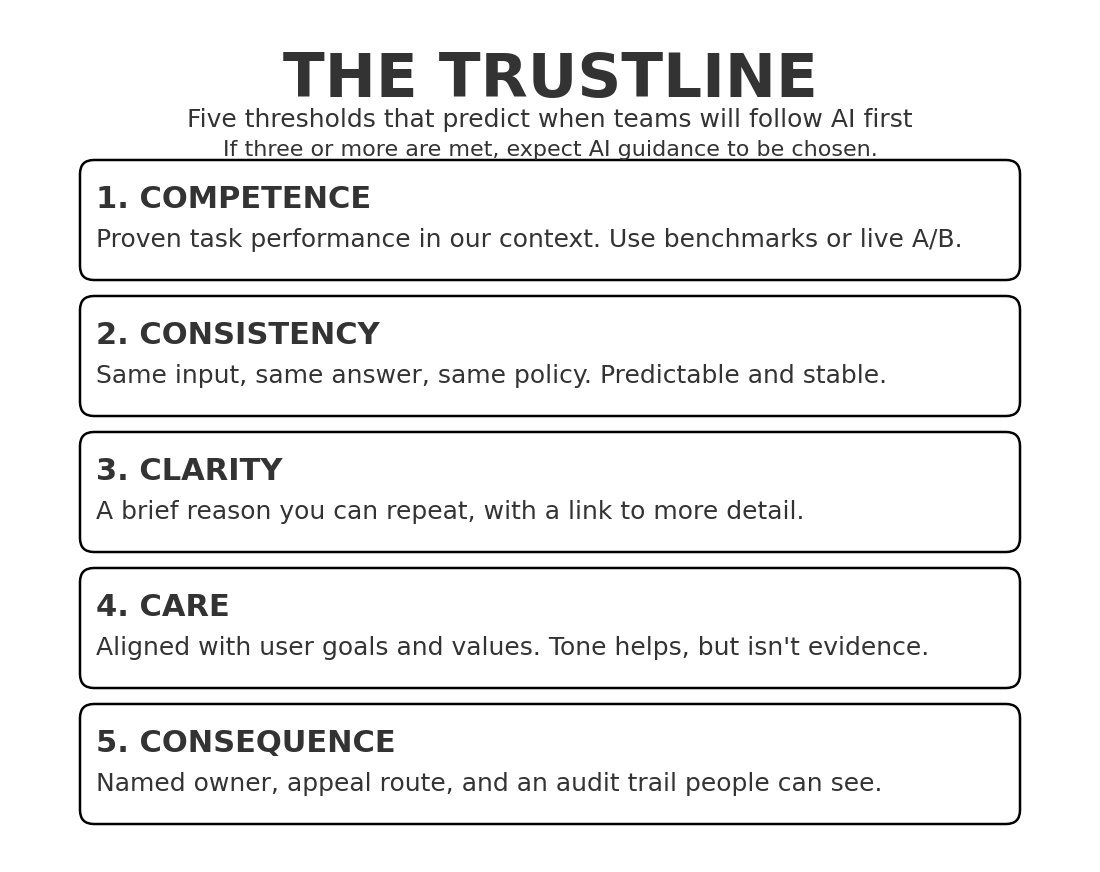
When I work with executive teams, we plot key decisions against five thresholds. If three are met at once, employees tend to follow the AI first. This model turns a stale debate into a useful diagnostic tool.
- Competence: Proven performance in the task, shown by benchmarks or live A–B tests in your context.
- Consistency: Same input, same answer, same policy. Predictability reduces bargaining and second-guessing.
- Clarity: A brief reason, plus a path to more detail when needed. The explanation must match both the risk and the reader.
- Care: Visible alignment with user goals and company values. Warm tone can help adoption, but tone is not evidence.
- Consequence: Named accountability if things go wrong. Without clear lines, people become moral crumple zones for automated choices.
This framework helps explain why an AI might win a specific moment. In hiring, it can shortlist from hundreds of applicants, propose the interview panel, and supply targeted questions in seconds. In promotions, it can propose a rating based on delivery against goals, peer feedback, and impact scores—all with a clear appeal route. This speed, specificity, and transparency are powerful catalysts for adoption.
Reclaiming Leadership Relevance: The Integrative Judgment Model
Authority does not vanish when teams consult AI. It changes its source. Leaders keep authority by designing how people and systems work together, then modeling that design in daily decisions. The goal is not to compete with AI but to harness its strengths while amplifying irreplaceably human leadership qualities.
The most effective leaders practice a Frame, then Edit methodology.
- Frame: State the question, the constraints, and what good looks like. Invite the AI’s options. “Our aim is a smooth policy rollout next week with zero compliance breaches. AI, give me two rollout plans that meet that standard.”
- Edit: Add context and values that only a leader can supply, then decide. “We will take Plan B. Add a one-minute pre-shift briefing and a same-day check with the HR business partner. Post the rationale and the appeal route on the team channel.”
This approach requires leaders to become champions of integrative judgment, consciously demonstrating how to blend data-driven insight with human wisdom. It also demands radical transparency. Instead of treating AI as a black box, forward-thinking companies hold “algorithmic transparency sessions” to discuss how tools arrive at their conclusions, building trust in both the technology and the leadership overseeing it.
Building Trust as a System: A Leader’s Blueprint
Trust grows from design choices people can see and use. These elements can be operationalized within a single quarter to provide tangible safeguards.
- Decision Cards & Advice Labels: For each AI tool, publish a one-page card with its purpose, inputs, known gaps, and accountable owner. In the interface, attach a small label to each recommendation with its intent, data scope, and confidence level. Treat these like nutrition facts for decisions.
- A Real Contestation Route: Provide a one-click appeal with a time-bound human review outside the original chain. Normalizing appeals turns complaints into structured data you can learn from.
- Measure Trust Directly: Track time to decision with AI in the loop, override rates by risk tier, explanation quality scores, and appeal volumes and outcomes. Report these trends to the leadership team to gauge health of the system.
- Set and Publish Scope: Create a three-tier map: AI-led with audit for routine items (e.g., leave eligibility), shared with sign-off for consequential items (e.g., promotions), human-led for sensitive items (e.g., disciplinary actions). Review quarterly.
A 90-Day Agenda for Implementation
For leaders ready to move from insight to action, the following agenda provides a path.
- Weeks 1-2: Diagnose. Map the key moments where employees already consult AI. Benchmark accuracy and error severity.
- Weeks 3-6: Design. Publish decision cards and install advice labels on one high-value workflow. Launch the appeal button.
- Weeks 7-10: Refine. Capture how employees use AI advice. Adjust prompts, thresholds, and escalation rules based on data.
- Weeks 11-12: Review and Scale. Share performance effects and improvements driven by feedback. Expand to a second workflow.
The Path Forward: A Strategic Imperative
The question is no longer if AI will alter the dynamics of trust within your organization, but how and to what effect. This is not a technological challenge to be delegated to IT; it is a core strategic imperative that sits at the intersection of human capital, organizational culture, and operational execution. The leaders who will define the next decade are those who approach this not with apprehension, but with a clear-eyed commitment to designing intentional, human-centric systems.
The goal is not to ensure employees believe their bosses over the machine, or vice versa. The goal is to architect an ecosystem of trust so robust that the source of advice becomes secondary to its quality, fairness, and utility. In this system, AI provides scalable competence and consistency, while human leaders provide ethical guardrails, contextual wisdom, and inspirational vision. They become the indispensable interpreters and integrators of machine-generated insight.
Your first move is critical. It sets the tone for everything that follows. Begin with a single process—recruiting, performance feedback, resource allocation—and apply the framework. Measure the impact on speed, quality, and employee confidence. Communicate the results with radical transparency. This disciplined, evidence-based approach transforms a theoretical risk into a manageable and powerful opportunity for evolution.
The future of leadership belongs to those who build this integrated trust deliberately.
References
- Drucker Institute. (2024). The Future of Trust in Management.
- Yale School of Management. (2023). Algorithmic Advice and Employee Disclosure.
- Brynjolfsson, E., Li, D., Raymond, L. R. (2023). Generative AI at Work. NBER Working Paper.
- Dietvorst, B. J., Simmons, J. P., Massey, C. (2015). Algorithm Aversion: People Erroneously Avoid Algorithms After Seeing Them Err. Journal of Experimental Psychology.
- MIT Sloan Management Review. (2024). The Integrative Leader: Blending Human and Machine Intelligence.
- NIST. (2023). Artificial Intelligence Risk Management Framework (AI RMF 1.0).
- ISO/IEC 23894:2023. Information Technology, Artificial Intelligence, Risk Management Guidelines.
First published on LinkedIn.