
Why treating all talent decisions as “AI-ready” is quietly undermining HR credibility, and what leaders must do differently.
A Necessary Distinction Most AI Strategies Ignore
In regulated and non-regulated environments alike, the question is no longer whether AI can be used in HR. That threshold has already been crossed. The harder question, and the one most strategies continue to avoid, is where AI influence remains appropriate once employee challenge, legal exposure, and reputational risk are taken seriously.
Most HR AI strategies still frame success in terms of organisational maturity. Platforms, data availability, governance frameworks, capability models, and sponsorship dominate the conversation. These elements matter, but they answer the wrong question. They describe readiness to deploy technology, not readiness to own and defend decisions influenced by it.
The distinction that matters is between capability and AI decision-level suitability. An organisation may be fully capable of applying AI to a people decision and still be strategically wrong in doing so. Suitability depends on the structure of the data, the reliability of the signal, the severity of consequences if the decision is wrong, and the organisation’s ability to explain and justify that decision under scrutiny. This is why governance frameworks that fail to discriminate between decision types often provide false reassurance rather than real control.
Risk does not emerge at the level of systems or policies. It materialises at the level of individual decisions affecting real people. One candidate screened out by an algorithm. One employee flagged as “high risk.” One promotion influenced by a model few leaders can clearly explain. These are the moments where AI influence becomes visible, contestable, and subject to challenge by employees, regulators, and governance bodies.
This article is not an assessment of AI adoption maturity. It is a decision-by-decision examination of the talent lifecycle, designed to answer a more uncomfortable question:
Which HR decisions are actually fit for AI influence, and which require human ownership regardless of how capable the technology appears?
The Strategy Mistake Hiding in Plain Sight
The so-called War for Talent is over. The real contest is now the War for Signal, meaning the ability to extract reliable insight from complex human data without distorting judgment. AI is embedded across almost every layer of the HR stack, yet many organisations struggle to articulate where it improves decision quality and where it quietly degrades it.
The problem is not ambition, nor is it tooling. It is a category error. A single, uniform AI strategy is applied across the entire talent lifecycle, as if all people decisions were structurally similar. They are not. Sourcing a candidate and judging a leader are fundamentally different classes of decisions. They involve different data, different risks, and different ethical thresholds.
This is not a critique of AI capability. It is an examination of leadership judgment under conditions of algorithmic influence. It is time to separate the Science of Leverage, where AI genuinely amplifies human capability, from the Art of Delusion, where confidence in technology outruns judgment.
From Funnel Thinking to a Circular Talent Lifecycle
The traditional linear talent funnel assumes a one-way journey that ends at offboarding. That model was serviceable in a pre-digital era, but it no longer holds in an AI-enabled organisation where data can and should circulate. Talent intelligence should flow continuously between sourcing, development, performance, and alumni networks.
In a circular talent lifecycle, offboarding is not an endpoint. It is an intelligence node. Insights gained at exit can inform future sourcing, development priorities, and retention strategies, provided leaders are willing to treat them as such.
AI does not play a single role across this loop. In some contexts it acts as a gatekeeper, filtering and ranking at scale. In others it acts as a guide, supporting navigation, development, and learning. Strategy fails when leaders ignore this distinction and deploy AI uniformly rather than intentionally.
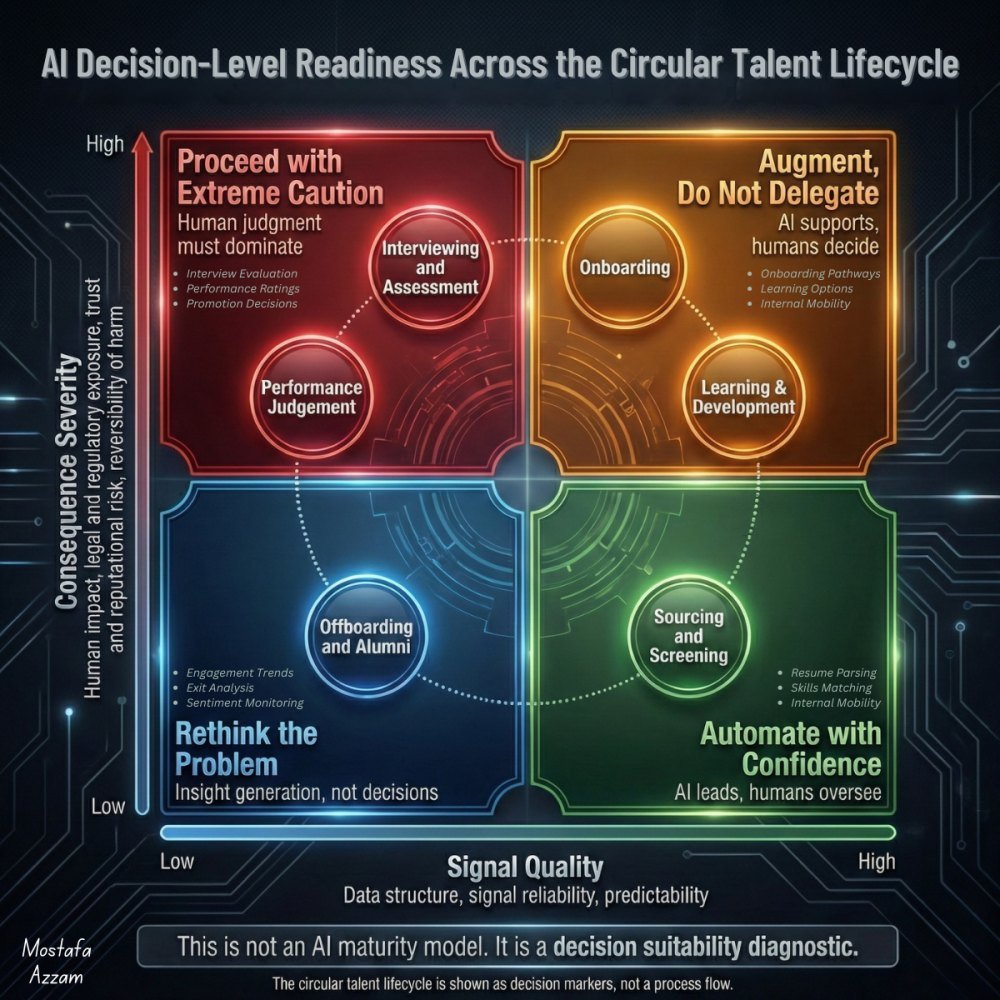
The lifecycle is used here not as a maturity model or process map, but as a sequence of decision contexts with very different characteristics, risks, and consequences. Each stage asks AI to do something fundamentally different.
For each stage, the assessment that follows is an AI decision-level suitability verdict. It reflects how appropriate algorithmic influence is for that type of decision, rather than how advanced the organisation’s tools or governance frameworks may be.
1. Sourcing and Screening Decisions: The Efficiency Trap
AI Decision-Level Readiness: Works mostly well
Sourcing and screening are where AI performs most reliably. The data is structured, signals are relatively clear, and success criteria are easier to define. Resume parsing, skills taxonomies, and ATS-driven ranking allow organisations to handle volumes that would overwhelm human teams.
The strategic cost emerges when efficiency is mistaken for effectiveness. By optimising for keywords and historical success patterns, organisations engineer a regression to the mean. AI quietly reproduces past hiring decisions, filtering out outliers, non-linear thinkers, and unconventional talent who often drive innovation.
AI excels at matching against known patterns. It is far weaker at discovering what does not yet fit the pattern. When leaders forget this distinction, they automate the gate so aggressively that culture is sanitised into mediocrity.
2. Interviewing and Assessment Decisions: Confidence Without Evidence
AI Decision-Level Readiness: Failing, high risk
Interview-stage AI is where many HR AI strategies collapse. Tools claiming to infer traits from voice patterns, facial micro-expressions, or behavioural cues project a level of certainty that the underlying evidence does not support.
Signal quality in short interviews is noisy, context-dependent, and culturally variable. Training models on historical hiring data automates past prejudice at scale, even when outputs appear objective and data-driven.
This is not advanced science. In many cases, it approaches digital phrenology. Human judgment, imperfect as it is, remains the superior sensor for genuine culture add and contextual interpretation at this stage.
3. Onboarding Decisions: Automation That Supports Belonging
AI Decision-Level Readiness: Very effective
Onboarding is the quiet success story of the HR AI lifecycle. It is a domain where automation and human experience reinforce one another rather than compete.
AI performs strongly in zero-touch provisioning, compliance workflows, and frequently asked questions. When friction disappears from logistics, managers regain time for context, connection, and belonging, which are the true drivers of early engagement.
The deeper opportunity lies in personalization. Interview insights, role expectations, and learning preferences can shape tailored early-stage experiences, turning generic welcomes into intentional roadmaps. AI succeeds here because it supports humans rather than scoring them.
4. Learning and Development Decisions: Where ROI Is Actually Created
AI Decision-Level Readiness: Huge potential, poorly architected
If HR AI strategy has a genuine ROI engine, it sits in learning and development. AI is not failing in this domain. Architecture is. Static LMS platforms and course catalogs were never designed for adaptive intelligence.
Recommendation engines, skills adjacency mapping, and AI tutors shift learning from “just in case” to “just in time,” aligning development with real performance needs. This is where AI stops being a cost centre and starts generating capability.
Most organisations underuse AI here because they are still building libraries instead of ecosystems. This is a design failure, not a tooling one.
5. Performance Judgement Decisions: The Illusion of Precision
AI Decision-Level Readiness: Limited value, high confidence risk
Performance remains one of the hardest domains for AI to model reliably. The data is subjective, context-heavy, and often lagging, even before algorithms are introduced.
AI introduces the risk of false precision. Dashboards appear authoritative while being mathematically derived from noise and bias. Confidence increases, but clarity does not, and measurement is mistaken for meaning.
Leaders must distinguish between surveillance and signal. Most current models still struggle to make that distinction, and HR credibility erodes when they are trusted too quickly in this domain.
6. Offboarding and Alumni Decisions: The Intelligence We Abandon
AI Decision-Level Readiness: Rarely used, high strategic value
Most organisations treat resignation as an endpoint. Data is archived or deleted, and insight is lost without reflection. This is a strategic blind spot.
AI can surface exit patterns, maintain alumni intelligence, and match returning talent to future roles. Skills gained elsewhere can re-enter the organisation through the boomerang effect, often at lower cost and higher quality than external sourcing.
If an AI strategy stops at exit, it is incomplete. Offboarding is not a failure state. It is an intelligence opportunity.
The Pattern Beneath the Lifecycle
Across the talent lifecycle, a single rule emerges with consistency:
The problem is not AI adoption. It is the failure to discriminate between decisions. HR strategy falters when leaders ignore where human authority must remain central, regardless of technological capability.
The Question HR Has Been Avoiding
The smarter question is not, “How can we use AI in HR?” That assumes use is the goal. The more difficult and valuable question is:
Which decisions are actually fit for AI influence, and which require human ownership no matter how advanced the technology becomes?
For your next strategy meeting, consider this carefully:
Across your talent lifecycle, where are you over-trusting AI to judge people, and where are you underusing it to develop them because leadership has not caught up yet?
Visit my website: www.thehrtalent.com
First published on LinkedIn.