
In the recent wave of technology-driven workplace transformations, few cases have captured attention quite like IBM’s AI-driven restructuring. In 2023, IBM made a bold strategic decision to replace thousands of jobs with artificial intelligence solutions. The aim wasn’t initially to automate HR specifically, but rather to target repetitive, rules-based tasks across the enterprise. However, when mapped against these criteria, HR roles emerged as one of the most suitable—and vulnerable—areas for automation. The result: approximately 8,000 HR jobs were streamlined through IBM’s AI-powered AskHR platform, which automated nearly 94% of routine HR functions, generating $3.5 billion in productivity gains.
Yet, despite these eliminations, IBM soon found itself rehiring—this time for roles requiring strategic insight, creativity, and cross-functional judgment. Similar developments unfolded at companies like Google, Spotify, and Duolingo, revealing a growing paradox: AI-driven automation doesn’t simply erase jobs; it reshapes them and demands new competencies in their place, giving way to new hiring, often at higher salaries and more advanced skill requirements. This indicates a broader economic shift, where automation isn’t just about job loss; it’s increasingly about job evolution.
IBM’s Unexpected Aftermath
IBM’s initiative initially focused on automating predictable processes—payroll, leave management, employee documentation. But as financial and human capital were freed up, the company reinvested heavily in growth areas, creating new roles in software engineering, AI design, marketing strategy, and L&D. IBM’s CEO, Arvind Krishna, publicly confirmed the company’s total headcount increased following the wave of automation—a critical point often lost in the public narrative.
Salesforce experienced a similar shift. When deploying AI agents to accelerate loan processing and systems training, the nature of employee roles changed dramatically. AI handled the time-consuming backend work, while humans transitioned to higher-value oversight, relationship management, and scenario evaluation roles—an early indication that AI wasn’t eliminating human input, but repositioning it.
The Fundamental Shift in HR Training Strategy
Traditionally, HR training workshops, including my own masterclasses, emphasized using AI to improve administrative efficiency—tasks now swiftly mastered by AI. IBM’s scenario signals a pivotal change: training HR professionals solely to enhance efficiency in automatable tasks is becoming redundant. The focus must shift toward reskilling and redeploying HR talent into roles AI struggles to replicate—strategic roles emphasizing empathy, complex interpersonal interactions, and nuanced decision-making.
A relevant example is Unilever’s AI-driven recruitment initiative, which automated candidate sourcing and initial assessments. Yet, despite significant efficiencies, Unilever quickly recognized the human role was critical in final candidate selection, cultural alignment, and ethical oversight. Consequently, Unilever now emphasizes training HR teams in strategic decision-making, bias management, and cultural stewardship rather than administrative execution.
The Hidden Curve: Agentic AI and the 5 Stages of Job Displacement
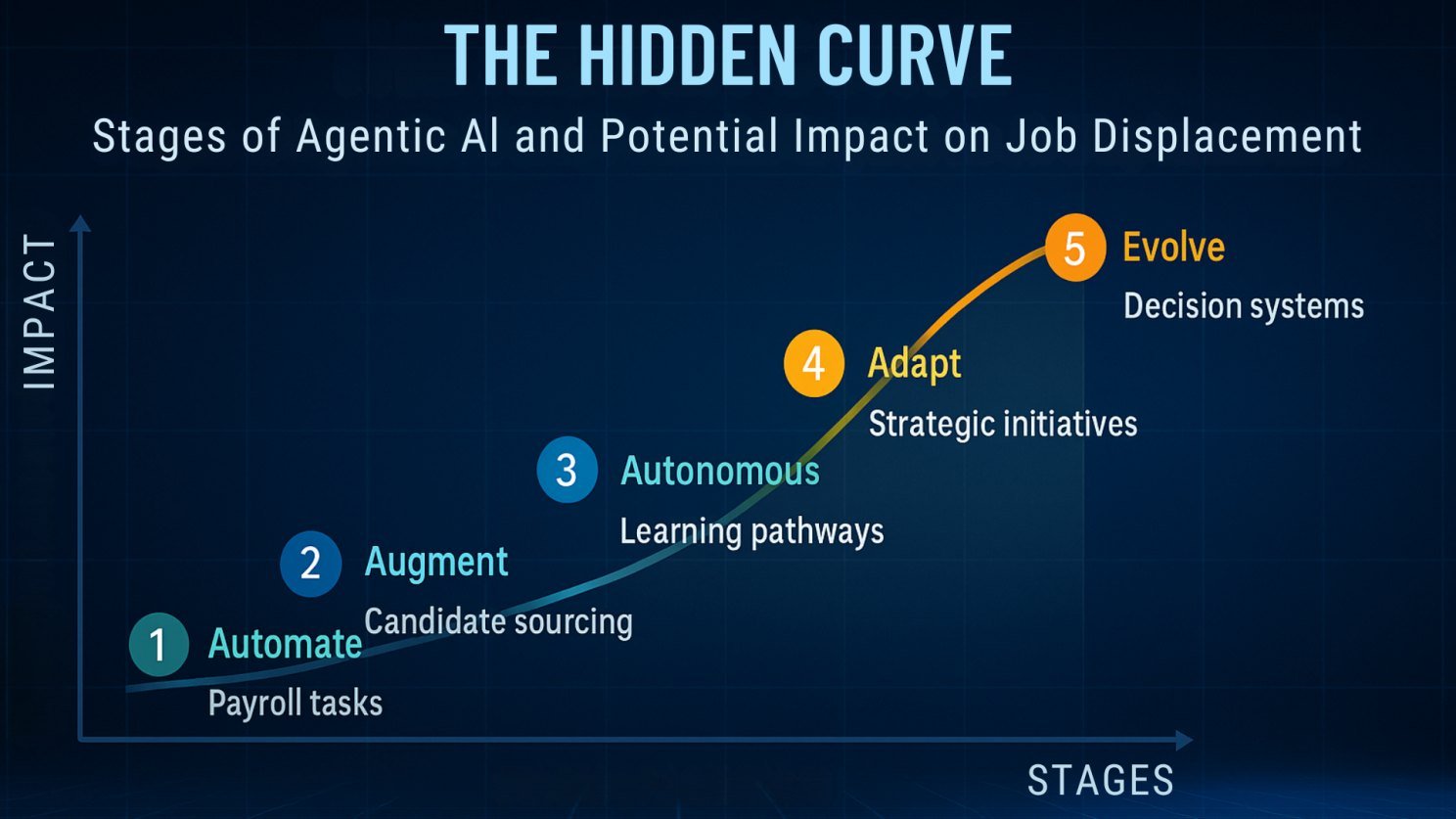
Agentic AI—systems capable of reasoning, planning, and acting autonomously—represent a turning point far beyond AI agents (simple automation). In a recent article, I laid out the evolution of AI agents into five stages:
- Stage 1: Task-Oriented Assistants – Automate basic, repetitive functions (e.g., answering routine HR questions). IBM’s AskHR fits this stage.
- Stage 2: Contextual Collaborators – Adapt to user intent, personalizing outputs (e.g., tailored onboarding or learning suggestions).
- Stage 3: Proactive Problem-Solvers – Anticipate issues and initiate actions without prompts (e.g., detecting burnout and intervening).
- Stage 4: Adaptive Strategists – Learn from outcomes, adjusting strategies in real time (e.g., evolving succession planning and team design).
- Stage 5: Autonomous Innovators – Redesign systems, innovate solutions, and act with near-complete independence.
IBM’s displacement of 8,000 roles using only Stage 1–2 agents should serve as a jarring wake-up call. What happens when Stage 3, 4, and 5 systems are deployed?
The likely answer: roles involving not just administration, but mid-level analysis, planning, and even elements of strategic decision-making will be under threat. In HR, this includes:
- Talent analytics roles overtaken by AI that can continuously model workforce dynamics
- L&D program managers replaced by agents that curate, deliver, and adapt personalized pathways in real time
- People partners displaced by agents analyzing sentiment, predicting attrition, and launching interventions autonomously
The curve of displacement is accelerating—and it’s largely invisible to those still focused on GenAI chatbots or automation pilots.
Strategic Workforce Planning: From Roles to Tasks
Strategic workforce planning now necessitates breaking jobs into constituent tasks, identifying tasks at risk of automation, and dynamically restructuring roles around distinctly human capabilities. This approach, successfully applied at IBM and Unilever, fosters continuous adaptability.
Google’s recent workforce analytics initiative exemplifies this strategy. Rather than viewing roles as fixed, Google analyzes jobs as task bundles, frequently revisiting them to identify those requiring human oversight and creativity. Roles are dynamically adjusted, ensuring continuous alignment with organizational strategy and technological capabilities.
Practical Considerations and Real-world Implications
Not every organization can smoothly implement this shift. Companies such as Spotify initially encountered difficulties balancing automation with essential human roles. Early attempts at automating customer support entirely resulted in subpar customer experiences, compelling Spotify to rapidly rehire skilled human customer service specialists. The lesson: successful AI integration requires careful calibration between human and automated contributions, underscoring the ongoing need for strategic human oversight.
Leading AI Adoption from HR
To ensure agentic AI becomes a force multiplier—rather than a displacer—HR must actively lead adoption with the right framing:
- Define outcomes, not tools: Anchor deployments in problems worth solving—not just tools worth experimenting with.
- Develop hybrid workflows: Design interactions where humans oversee, refine, and learn from AI agent decisions.
- Champion governance: Lead explainability and transparency efforts through agent audit trails and ethical review loops (e.g., SAP’s Agent Audit Protocol).
HR shouldn’t be asking “how do we use AI?”—but “how do we lead our organization through AI?”
Mitigating Strategic Risk
While some risk is technical (bias, opacity, data), the deeper risk is strategic myopia—failing to anticipate what advanced agents may displace until it’s too late. To mitigate:
- Audit job architectures: Identify task-level exposure to each AI agent stage.
- Use simulations: Model workflow shifts before deployment.
- Educate executives: Ensure C-suite leaders understand the full scope of agentic impact—not just efficiency metrics.
In other words: HR must become fluent in the future it hopes to shape.
Leadership Evolution: Architects of Decision Systems
With AI increasingly managing routine decision-making, human leaders must evolve from task managers to decision architects—designing and overseeing autonomous systems rather than directly executing decisions. SAP, for instance, has developed an Agent Audit Protocol (AAP), ensuring AI-driven decisions within HR maintain transparency, accountability, and ethical standards. Human oversight is thereby elevated, concentrating on ensuring ethical alignment and strategic coherence.
As I explore in my upcoming book, The Algorithmic Leader: Rethinking Leadership, Culture, and Capability in AI-Augmented Organizations, this shift marks a deeper transformation in the nature of leadership. Today’s leaders are no longer defined by authority or hierarchy but by their ability to frame intelligent outcomes, design adaptive structures, and ensure human-machine collaboration remains values-driven. The most effective leaders will not be those who control decisions, but those who design the systems in which the best decisions can emerge—fluidly, ethically, and in real time.
The Indispensable Human Advantage
IBM’s experience vividly illustrates that while automation efficiently handles routine tasks, strategic judgment and empathy remain distinctively human. For instance, agentic AI might quickly flag potential employee attrition risks, yet human managers must thoughtfully and empathetically address underlying employee concerns.
Emerging HR Roles in the Age of Agentic AI
As traditional HR responsibilities become increasingly automated, new roles are emerging that blend strategic thinking, ethical oversight, and technological fluency. Among them:
- AI Operations Partner: Oversees human-AI collaboration, ensuring agentic outputs align with organizational values and compliance requirements.
- Capability Architect: Designs dynamic career pathways and workforce models based on real-time data and predictive insights.
- Talent Intelligence Analyst: Leverages agentic AI to anticipate skills gaps, analyze internal mobility opportunities, and guide reskilling efforts.
- Employee Experience Curator: Integrates agentic sentiment and feedback tools to design emotionally intelligent, adaptive workplace experiences.
- HR Ethics and Governance Lead: Builds and monitors frameworks that safeguard fairness, transparency, and explainability in all AI-supported HR systems.
These roles don’t replace the HR profession; they reimagine it. They reflect the hybrid capabilities HR will need to stay relevant and influential in an AI-powered organizational ecosystem.
A Call for Action: Strategic Reinvention in HR
The IBM paradox exemplifies an essential lesson: HR professionals must proactively lead the strategic reinvention of their roles—not as administrators managing transactions, but as architects orchestrating complex human-AI ecosystems. Practical actions include:
- Reskilling HR teams in strategic oversight, bias management, and ethical AI governance.
- Dynamically restructuring roles around tasks resistant to automation, such as strategy formulation, cultural leadership, and empathy-driven management.
- Leveraging agentic AI to handle complex, multi-step workflows, while ensuring human roles remain central in strategic oversight and decision-making.
HR professionals must actively define their future, transitioning into roles that AI complements rather than replaces. IBM, Unilever, Salesforce, and Google offer valuable blueprints for navigating this crucial transformation, demonstrating how strategic human oversight remains irreplaceable even in the era of sophisticated AI. The challenge ahead lies not merely in embracing AI but in redefining human roles strategically and sustainably for lasting organizational impact.
Where to Start: A Strategic Prompt for HR Leaders
The first step isn’t technical—it’s diagnostic. HR leaders should begin by conducting a task-level audit of their current workflows. Break each HR role down into constituent tasks. Then assess which are at high risk of automation and which require uniquely human strengths. Use this map to prioritize:
- Which tasks can be delegated to Agentic AI.
- Which roles should be restructured or redeployed.
- What new skills and roles your HR function must begin preparing for—today.
It’s not about reacting to AI; it’s about anticipating what’s next. And in doing so, ensuring HR’s evolution is not just reactive, but strategically designed and future-ready.
References
Deloitte. (2024). Global human capital trends: From workforce to worknet. Deloitte Insights. https://www2.deloitte.com
Eightfold AI. (2023). Talent intelligence platform case studies. https://eightfold.ai
IBM. (2023, May). IBM laid off 8,000 employees to replace them with AI. Farmingdale-observer.com
McKinsey & Company. (2022). The state of AI in 2022: And a half-decade in review. https://www.mckinsey.com
Salesforce. (2024, March). Rise of AI agents means ‘every job should be rethought’. Fortune Magazine. https://fortune.com
Unilever. (2021). Case study: AI in recruitment and talent strategy. Harvard Business Review. https://hbr.org
World Economic Forum. (2023). The future of jobs report 2023. https://www.weforum.org/reports/the-future-of-jobs-report-2023
Azzam, M. (2025). The Hidden Curve: Stages of Agentic AI and Potential Impact on Job Displacement. From From Transactional Admin to AI Architect: How HR Must Reinvent Itself to Stay in the Game!
First published on LinkedIn.